
Early Education Program
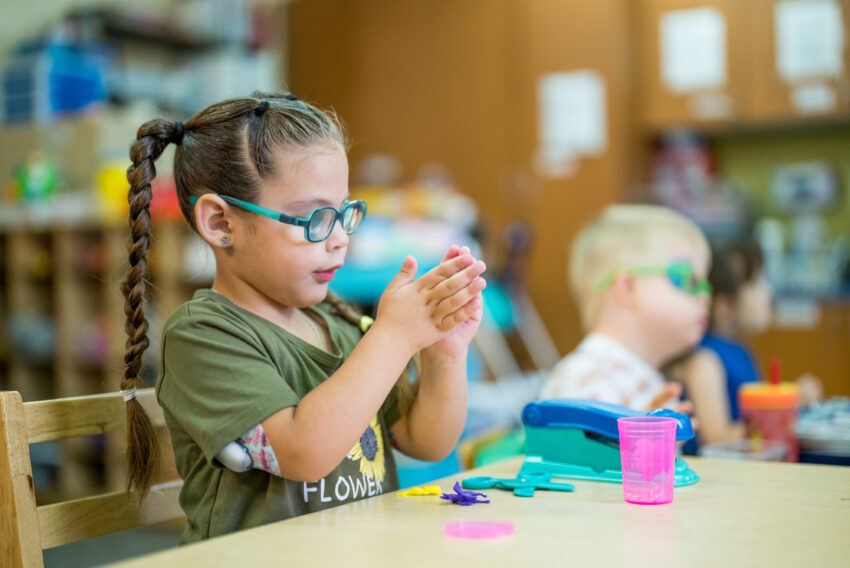
Preparing children with vision loss for a successful transition into school
Vision Forward’s Early Education Program is comprised of a variety of playgroups, sensory clubs, and other small groups designed to provide holistic support to children with vision loss ages 0 to 6+ and their families. In addition to incorporating all areas of development, infants, toddlers, and young children with visual impairments and their caregivers receive comprehensive, disability-specific support targeting skills of the Expanded Core Curriculum, including compensatory (tactual and auditory) skills, cognition and play skills, and social interaction skills.
Children with visual impairments and/or other disabilities, as well as typically developing peers, are welcome. These small groups take place on-site at Vision Forward and at partnering agencies, such as local community centers, fostering community inclusion, specialized skill development, and emotional well-being.
Our small groups are tailored to the developmental needs of each child and enhance school readiness, independence, and socialization. Depending on individual goals, developmentally appropriate groups may include caregivers, siblings, and extended family to create a supportive network that strengthens the entire family’s ability to thrive.
See our program fees here.
Our program provides a wide array of collaborative services that promote preschool readiness and the development of each child. Our small groups combine developmentally appropriate activities with the Expanded Core Curriculum (ECC) for children who are blind or visually impaired to ensure they learn the skills essential to succeed in school and life. The ECC is used as a framework for assessing children, planning individual goals, and providing instruction to learn the foundational skills necessary for future educational success. Children learn through play and exploration. Since caregivers stay on-site at all times, they are also invited into the classroom, so they can practice carryover skills into the home. Caregivers will also have the opportunity to learn more about the curriculum at parent meetings or at conferences.
The ECC is used to define concepts and skills that often require specialized instruction with children who are blind or visually impaired to compensate for decreased opportunities to learn incidentally by observing others.
Family Connections offers a variety of events and services designed to create meaningful opportunities for families to learn, connect, and grow together. These include training courses, conferences, caregiver matches, and support groups.
Learn more about Family Connections here.
EARLY EDUCATION GROUP OPTIONS
EYE Grow
Whether you’re a new parent, grandparent, or caregiver, this group provides a nurturing space to connect, learn, and grow—together.
Schedule: 1 Hour, 2 Days Per Week (Monday/Wednesday or Tuesday/Thursday)
Time: 9:00 – 10:00 AM
Ages: Approximately 0–18 Months (developmentally)
Group Size: 4–6 Children, Accompanied by Caregiver
Location: Vision Forward Association
Program Overview:
EYE Grow is a thoughtfully designed early development program tailored for infants aged 0 to 18 months and their caregivers. Offered twice a week in small-group sessions, this 1-hour program nurtures foundational growth through sensory-rich experiences and intentional parent-child bonding activities specifically created for young children who are visually impaired. Each group is guided by an experienced facilitator and includes structured and unstructured components that promote exploration, interaction, and developmental milestones. The program prioritizes a calm, engaging environment that allows infants to grow at their own pace while strengthening the caregiver-child connection.
Program Focus Areas
Sensory Experiences: Tactile play, visual stimulation, gentle sounds, and age-appropriate movement help stimulate the senses and support cognitive development.
Early Development: Activities support fine and gross motor skills, social interaction, language exposure, and early emotional regulation.
Parent-Child Bonding: Through shared play, songs, and routines, caregivers gain tools to deepen attachment, understand developmental cues, and build confidence in their role as a caregiver for a child with visual impairment.
Program Goals:
- Foster early developmental milestones in a supportive environment
- Encourage meaningful caregiver-infant interactions
- Build community among participating families
- Introduce routines that can be continued at home
Register here for EYE Grow
See our program fees here.
EYE Play
This group offers a dynamic space for toddlers to discover their world through play—building confidence, curiosity, and connection every step of the way.
Schedule: 2 Hours, 2 Days Per Week (Monday/Wednesday or Tuesday/Thursday)
Time: 9:00 AM – 11:00 AM
Ages: Approximately 18–36 Months Developmentally
Group Size: 4-6 Children per Session, Accompanied by Caregiver
Location: Vision Forward Association
Program Overview:
EYE Play is an engaging and developmentally enriching program designed for toddlers with visual impairments aged 18 to 36 months and their caregivers. Held twice a week in small-group sessions, this 2-hour program supports toddlers through purposeful play that fosters sensory exploration, milestone development, and early learning in a supportive, social environment. Led by skilled early childhood facilitators, each session combines guided activities with open-ended play, giving toddlers the freedom to explore while gently introducing structure. With caregivers actively participating, EYE Play helps strengthen the bond between adult and child while promoting social interaction among peers.
Program Focus Areas
Developmental Milestones: Activities that are designed to support speech and language development, motor coordination, social-emotional growth, and emerging independence.
Sensory Exploration: Hands-on experiences with different textures, sounds, and materials encourage curiosity and support brain development.
Multi-Sensory Play Skills: Children engage in play that integrates movement, music, tactile materials, and pretend scenarios to build cognitive and physical skills.
Program Goals:
- Support toddlers through key developmental transitions
- Encourage sensory-rich, purposeful play
- Promote early socialization and communication
- Strengthen caregiver understanding of child development and carryover at home through shared activities
Register here for EYE Play
See our program fees here.
EYE Learn
The EYE Learn classroom is a place where curiosity is encouraged, abilities are celebrated, and every child is supported in reaching their fullest potential—ready for school and ready for life.
Schedule: Half Days, 4 Days/Week (Monday–Thursday
Session Times: AM (9:00 AM – 12:00 PM) or PM (1:00 PM – 3:30 PM)
Ages: 2–6 Years (Grouped by Developmental Level)
Group Size: 6–8 Children, Accompanied by Caregiver
Location: Vision Forward Association
Program Overview:
EYE Learn is a comprehensive early education program focused on preparing children with visual impairments ages 2 to 6 for a successful transition to school. Designed with school readiness at its core, this program supports every area of a child’s development through structured routines, intentional play, and hands-on learning experiences. Children are grouped by developmental level, allowing facilitators to tailor activities to best meet individual needs and outcomes. Sessions are offered in the morning or afternoon, with caregivers participating alongside their children and/or waiting nearby to encourage learning, promote bonding, foster independence, and support skill-building in real time.
Learning in the EYE Learn classroom happens naturally through play, exploration, and everyday experiences. Children are encouraged to use their senses as they explore a variety of materials—manipulatives, music, movement, nature, and dramatic play—within a developmentally appropriate and inclusive setting. Daily living skills are integrated into routines, reinforcing independence in a practical, supportive way.
Each child’s goals are developed based on their unique strengths, needs, and interests. This individualized approach allows children to grow at their own pace, building a strong foundation not only for school, but for lifelong learning and development.
Program Focus Areas:
Pre-Academic Skills: Early exposure to literacy, numeracy, problem-solving, and classroom routines helps children build confidence and readiness for formal education.
Social Interactions: Small-group settings with peer models encourage communication, cooperation, and relationship-building.
Self-Regulation: Children learn emotional awareness, transitions, and daily routines to support focus, flexibility, and independence in a group setting.
Program Goals:
- Support growth in all areas of development
- Promote independence through daily living skills
- Prepare children for a successful school experience
- Encourage caregiver involvement and empowerment
Provide inclusive, individualized learning experiences
Register here for EYE Learn
See our program fees here.
EYE Explore
EYE Explore is a gentle, joyful introduction to group activities for young children—a space to connect, explore, and grow together, one Friday at a time.
Schedule: 1 Hour, 1 Day per Week (Fridays; Other days based on interest)
Ages: 0–6 Years
Group Size: 4–6 Children per Session, Accompanied by Caregiver
Location: Vision Forward Association and/or Community-Based Settings (Community locations, such as community centers, based on family interest)
Program Overview:
EYE Explore is a welcoming, play-based program designed for children with visual impairments ages 0–6 and their caregivers. Offered once a week in small group settings at Vision Forward Association and/or various community locations, this 1-hour group provides a calming and engaging environment where young children can explore sensory-rich activities, build developmental skills, and strengthen bonds with their caregivers through play. Each group is led by an experienced Vision Forward staff member and held in accessible community locations to encourage comfort and participation for all families. Groups are limited to 6-8 children to allow for individualized attention and inclusive participation. EYE Explore is open to children of all abilities, with a focus on supporting developmental growth in a low-pressure, social setting.
Program Focus Areas:
Sensory Experiences: Activities are centered around touch, sound, movement, and visual exploration to help regulate and stimulate the senses in a developmentally appropriate way.
Early Development:
The program promotes fine and gross motor skills, communication, and cognitive growth through age-appropriate, play-based engagement.
Parent-Child Bonding:
Shared experiences foster strong relationships, build trust, and give caregivers ideas and tools for connection beyond the session.
Program Goals:
- Create a safe, sensory-friendly space for exploration and growth
- Support children’s sensory and developmental needs
- Strengthen caregiver-child relationships through shared play
- Build a sense of community among families
Register here for EYE Explore
See our program fees here.
Early Education Groups Form
"*" indicates required fields
Early Education Resources:
Children’s Program Family Handbook
Contact Colleen Kickbush, MSEd., TVI, DTVI | Director of Children’s Services
at 414-403-8683 or ckickbush@vision-forward.org